


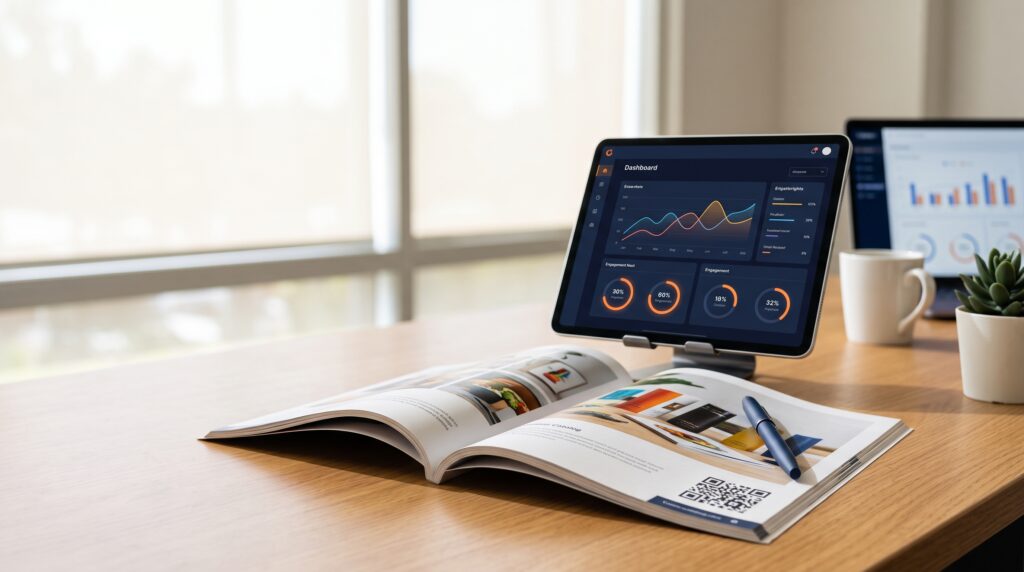
In Irvine, where tech companies and retail brands compete for attention across a crowded digital landscape, print remains a critical anchor for omnichannel campaigns. The most effective marketing strategies here don’t treat print as a relic; they use it to close the gap between online engagement and physical action. Whether you’re running a local B2B service or a consumer retail brand, integrating direct mail, signage, and large-format graphics with your digital ads increases recall and conversion rates by giving customers a tangible touchpoint that reinforces your online message.
Why Print Still Matters in a Digitally Saturated Market
Digital advertising is easy to ignore. Banner blindness is real, and the average consumer sees thousands of digital messages daily, most of which are forgotten within seconds. Print, however, demands a different kind of attention. A well-designed piece of mail or a storefront sign holds the viewer’s focus longer because it occupies physical space. In a city like Irvine, where the demographic is highly educated and affluent, quality print signals credibility and investment in the brand.
Print also serves as a trust anchor. When a customer sees a consistent message across a Facebook ad, a Google search result, and a professional brochure or vehicle wrap, the repetition builds legitimacy. Digital ads can feel ephemeral; a thick business card with a spot UV finish feels permanent. That psychological shift is why successful omnichannel strategies in Irvine are not abandoning print—they are making it work harder alongside digital channels.
Using QR Codes and PURLs to Bridge Print and Digital
The most direct way to connect print to your digital funnel is through scannable elements. QR codes are no longer a novelty; they are a standard expectation. But the execution matters. A tiny QR code buried in a corner of a postcard gets ignored. A large, high-contrast code with a clear value proposition—”Scan for 15% off your first order”—gets used.
Here is a practical workflow for making print drive digital action:
- Segment your audience: Send different offers to different neighborhoods in Irvine to test response rates.
- Use a dedicated landing page: Do not send people to your homepage. Create a specific URL that matches the print piece’s message.
- Track the code: Use a unique QR code per campaign so you can measure which print pieces drive traffic.
- Retarget the visitors: Install a pixel on the landing page so you can follow up with digital ads to those who scanned but did not buy.
For B2B companies in Irvine, personalized URLs (PURLs) work even better than generic QR codes. Sending a direct mail piece with a URL like yourcompany.com/johnsmith makes the recipient feel the piece was made for them. It is a simple touch, but it increases response rates because it bridges the physical piece directly to a digital experience tailored to that individual.
Print as the Retargeting Mechanism
Digital retargeting follows users around the web. Print retargeting works differently but is just as powerful. If a prospect visits your site but does not convert, you can trigger a physical mailer to their office or home within 48 hours. This is called programmatic print, and it is one of the most effective uses of print in an omnichannel strategy. The prospect has already shown interest; the print piece provides a tactile reminder that a pop-up ad cannot match.
Large Format Print for Events and Retail Presence
Irvine hosts a steady stream of industry conferences, trade shows, and community events. In these settings, your digital presence is secondary; the physical environment is everything. A trade show booth with high-quality backdrop walls, retractable stands, and table covers creates a professional perimeter that invites conversation. Attendees judge your company by the quality of your display. A flimsy banner with faded colors suggests a weak operation, regardless of how polished your website is.
Large format print also drives foot traffic in retail. Window graphics, including perforated film that allows passersby to see inside while displaying a massive brand message, turn a storefront into a billboard. Anti-slip floor graphics near the entrance can promote a specific product or a loyalty program sign-up. These are not decorative elements; they are functional touchpoints that guide the customer journey from the sidewalk into the store and, eventually, to a digital interaction.
Direct-to-Substrate Printing for Premium Branding
One of the most underused tactics in omnichannel marketing is direct-to-substrate printing on rigid materials. A UV flatbed printer can print directly onto acrylic, wood, metal, glass, and foam board. This opens up options for high-end signage and displays that standard vinyl cannot achieve. For example, a real estate agency in Irvine might use a brushed aluminum sign for a luxury listing, or a restaurant could use printed acrylic menu stands that match the interior design. These pieces are durable and look expensive because they are expensive to produce—which is exactly the point. They signal that your brand cares about the details.
Vehicle Wraps: Mobile Billboards That Reinforce Digital Campaigns
Irvine has heavy commuter traffic on the 5, 405, and 405 freeways. Vehicle wraps turn that traffic into an advertising channel. A single wrapped van or fleet vehicle generates thousands of impressions per day. The key is to align the wrap’s message with your current digital campaign. If you are running a seasonal promotion online, the wrap should reflect that same offer and visual language. This creates a cohesive brand experience when a potential customer sees your van on the road and then searches for you on their phone.
Vehicle graphics work best for local service businesses: plumbing, electrical, landscaping, catering, and delivery services. The wrap is a passive advertising channel that works 24/7 without ongoing ad spend. For a modest investment compared to digital ad campaigns, a full wrap can last five years or more, making it one of the lowest cost-per-impression options available in Orange County.
Business Cards and Print Collateral: The Handoff Moment
Digital communication has not killed the business card; it has made it more important. When you meet a prospect at a networking event in Irvine, exchanging contact info via LinkedIn is easy. But handing over a premium business card with a raised spot UV finish makes a stronger impression. It is a physical artifact that says you invest in your brand. The same applies to presentation folders, brochures, and proposal documents. In a B2B sales cycle, the quality of your printed collateral often reflects the quality of your service.
Here is what separates a forgettable card from a memorable one:
- Thick stock: Standard 14pt card stock feels flimsy. Upgrade to 32pt or thicker for a substantial feel.
- Spot UV coating: A raised, glossy finish on your logo or name adds a tactile dimension that catches the eye.
- Matte base with gloss accents: The contrast between a matte background and a glossy logo is a premium look.
- Foil stamping: Metallic foil in gold, silver, or copper adds a level of sophistication that is hard to ignore.
These details matter because they create a sensory experience that digital media cannot replicate. When a prospect holds your card, they are subconsciously evaluating your company’s standards. A premium card is a low-cost way to pass that test.
Print Signage as a Local SEO Signal
There is a direct connection between physical signage and local search performance. When a customer sees your storefront sign or a yard sign in their neighborhood, they are more likely to search for your business by name on Google. That branded search is a strong signal to search engines that your business is relevant and trusted. Additionally, consistent signage with your exact business name and address reinforces your NAP (Name, Address, Phone) citations, which are a core factor in local pack rankings.
For multi-location businesses in Irvine, directional signage and A-frames placed strategically near high-traffic intersections can drive both foot traffic and branded searches. The physical presence of signage validates your digital listings. If your Google Business Profile says you are at a specific address, but the storefront has no visible sign, customers get confused and trust drops. Aligning your physical signage with your digital presence is a foundational omnichannel practice.
Measuring the ROI of Print in an Omnichannel Campaign
Print is often criticized for being hard to measure. That criticism is outdated. With the right setup, print is as trackable as email or PPC. You just have to build the measurement into the campaign from the start.
Here are the practical metrics to use:
| Metric | How to Track It | What It Tells You |
|---|---|---|
| QR code scans | Unique code per print piece | Which offers and segments perform best |
| PURL visits | Unique URL per recipient | Individual response rates and conversion paths |
| Call tracking | Dedicated phone number on print ads | Direct response from print to phone inquiries |
| Promo code usage | Unique discount code printed on the piece | In-store or online redemption rate |
| Landing page conversions | UTM parameters on the printed URL | End-to-end ROI from print to sale |
The mistake most companies make is treating print as a standalone channel. When you integrate print with digital tracking, you can see exactly which pieces drive traffic and which ones miss. This allows you to iterate on design, offer, and targeting without guessing.
Cost Factors for Print in Irvine
Pricing for print varies significantly based on materials, quantity, and finishing. A basic vinyl banner might cost a few dollars per square foot, while a direct-to-substrate acrylic sign with custom mounting runs much higher. Vehicle wraps are typically priced by the square footage of the vehicle plus labor. A full wrap on a standard van can range from $2,500 to $4,500 depending on the complexity of the design and the amount of surface area. Trade show displays are similarly variable, with pop-up systems starting around $500 and custom backwalls reaching several thousand dollars.
When budgeting for an omnichannel campaign, allocate print based on the value of the customer you are targeting. A high-ticket B2B sale justifies a premium direct mail piece with spot UV and thick stock. A low-margin consumer product might be better served by a simple postcard. The goal is not to spend the most on print; it is to spend the right amount to achieve the desired response rate.
Common Mistakes to Avoid with Print in Omnichannel
Even with the best intentions, brands make errors that undermine the effectiveness of print. The most common is a mismatch between the print piece and the digital landing page. If your postcard promises a specific offer, the landing page must deliver that exact offer immediately. Sending users to a generic homepage is a conversion killer.
Another frequent mistake is poor design execution. Low-resolution images, inconsistent colors, and weak typography make the brand look amateurish. Print is permanent; a typo or a color mismatch cannot be fixed with a quick edit. Proofing is non-negotiable. A third mistake is ignoring the timing of the campaign. If you are running a digital promotion for a weekend event, the print piece must arrive at least five to seven days before the event to allow for planning.
Finally, do not treat print as a one-off. Consistency matters. A single postcard will not move the needle. A series of three or four touches over several weeks builds familiarity and trust. This is the same principle that makes retargeting ads effective digitally; print just requires more patience because the delivery cycle is longer.
Integrating Print with Your Existing Digital Workflow
The best way to think about print is as a companion to your digital channels, not a competitor. Start by identifying the weakest point in your current funnel. If you have high website traffic but low conversion, a direct mail piece to warm leads might be the push they need. If you have strong foot traffic but low online engagement, a window graphic with a QR code to a review site or a loyalty program can bridge the gap.
For businesses in Irvine looking to execute this strategy, working with a local printer that understands the technical requirements matters. A provider with UV flatbed capability can handle rigid materials like acrylic and wood, which opens up design options that standard offset printing cannot match. They can also manage installation for large-scale projects like murals and wraps, ensuring the final result looks as intended. You can explore the range of options available through Irvine Printing to see what fits your campaign needs.
Designing for Print and Digital Simultaneously
Designing a campaign that works across print and digital requires a different mindset than designing for one channel. The print piece needs to be legible from a distance or at a glance, while the digital asset can be more detailed. Start with the core message and visual identity, then adapt the layout for each medium. A banner on a trade show wall needs large text and bold imagery; the corresponding email can use the same imagery but include more copy and a clear call-to-action button.
FAQ
How quickly should I expect results from a print campaign?
Direct mail typically takes one to two weeks to show measurable response, depending on the audience and the offer. Large format signage and vehicle wraps are longer-term investments that build impressions over months, not days. Set expectations accordingly and measure against a baseline.
Is print more expensive than digital advertising?
On a cost-per-impression basis, print is often more expensive. But on a cost-per-conversion basis, print can be cheaper because it is more targeted and has higher engagement rates. The key is to use print for specific segments where the response value justifies the cost.
Can I use the same files for print and digital?
No. Print files require higher resolution (300 DPI) and CMYK color mode, while digital files are typically 72 DPI and RGB. You need separate file versions for each channel to ensure accurate color and sharpness.
Visit Irvine Printing